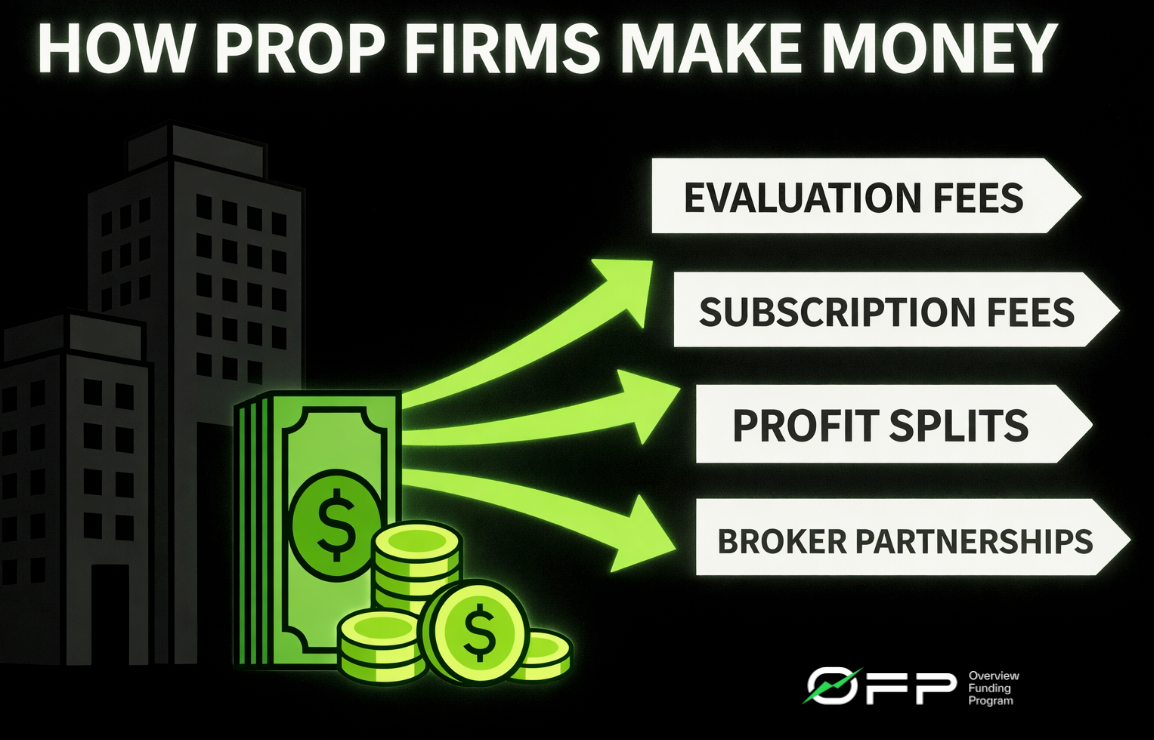
If you’ve ever looked into prop trading, you’ve probably asked yourself a simple question: how do prop trading firms actually make money?
It’s a fair question. After all, many firms advertise funded accounts, profit splits, and large amounts of trading capital. From the outside, it can be hard to understand how the business model works.
The reality is that prop firms generate revenue through several different channels. Understanding how these models work can help traders choose a firm that is built to last.
The Core Idea Behind Prop Trading
At its core, a proprietary trading firm provides traders with access to capital. Instead of risking their own funds, traders operate under the firm’s structure and follow specific risk rules.
When traders generate profits, those profits are shared between the trader and the firm. This is called the profit split, and it is one of the main ways prop firms earn revenue.
However, profit splits are only one piece of the picture.
Evaluation and Account Fees
One of the most common ways prop firms generate revenue is through evaluation fees.
In many traditional prop firms, traders must complete a challenge before receiving a funded account. To participate in this evaluation process, traders pay a fee that grants them access to the challenge account.
These fees vary depending on the size of the account and the structure of the firm. Some traders pass the challenge and move on to funded trading, while others do not complete the evaluation.
Because many traders attempt challenges multiple times, evaluation fees can represent a significant part of a firm’s income.
Trading Performance
Another source of revenue comes directly from trading performance.
When traders generate profits, the firm typically keeps a percentage of those gains. For example, if a trader makes a profit and the agreement includes a profit split, the firm receives its portion.
In this model, both the trader and the firm benefit when trading is successful. It aligns incentives between the two sides, encouraging disciplined trading and responsible risk management.
Risk Management Models
A key component of the prop firm model is risk management. Firms implement rules such as maximum drawdown limits and position size restrictions to protect capital.
By managing risk carefully, firms can maintain a sustainable system where traders can operate without exposing the company to excessive losses.
This structure is essential for maintaining stability in the long term.
Different Business Models in the Industry
Not all prop firms operate the same way.
Some firms rely heavily on evaluation challenges, while others focus on models that give traders access to capital more quickly.
For example, companies like OFP Funding have developed an instant funding model, where traders can start trading capital without passing a multi-stage challenge first.
This approach focuses on allowing traders to begin trading immediately while still respecting structured risk rules.
Why Transparency Matters
Because there are different business models in the prop trading industry, transparency is extremely important.
Traders should always understand:
- How payouts are processed
- What risk rules apply
- How profit splits work
- What fees are involved
Firms that clearly explain their structure tend to build stronger trust with their trading communities.
The Bottom Line
Prop trading firms make money through a combination of evaluation fees, profit splits, and sustainable risk management structures.
While the details vary from firm to firm, the goal remains the same: create a system where traders can access capital and firms can operate a stable business model.
For traders, the most important factors are transparency, consistent payouts, and fair trading conditions.
Understanding how prop firms operate is the first step toward finding a structure that aligns with your trading goals.
'%3e%3cellipse%20cx='694.451'%20cy='616.029'%20rx='390.451'%20ry='312.029'%20fill='var(--fill-0,%20%235473FF)'%20fill-opacity='0.49'/%3e%3c/g%3e%3cdefs%3e%3cfilter%20id='filter0_f_0_375'%20x='0'%20y='0'%20width='1388.9'%20height='1232.06'%20filterUnits='userSpaceOnUse'%20color-interpolation-filters='sRGB'%3e%3cfeFlood%20flood-opacity='0'%20result='BackgroundImageFix'/%3e%3cfeBlend%20mode='normal'%20in='SourceGraphic'%20in2='BackgroundImageFix'%20result='shape'/%3e%3cfeGaussianBlur%20stdDeviation='152'%20result='effect1_foregroundBlur_0_375'/%3e%3c/filter%3e%3c/defs%3e%3c/svg%3e)
'%3e%3cellipse%20cx='547.5'%20cy='498.5'%20rx='243.5'%20ry='194.5'%20fill='var(--fill-0,%20%235473FF)'%20fill-opacity='0.49'/%3e%3c/g%3e%3cdefs%3e%3cfilter%20id='filter0_f_0_102'%20x='0'%20y='0'%20width='1095'%20height='997'%20filterUnits='userSpaceOnUse'%20color-interpolation-filters='sRGB'%3e%3cfeFlood%20flood-opacity='0'%20result='BackgroundImageFix'/%3e%3cfeBlend%20mode='normal'%20in='SourceGraphic'%20in2='BackgroundImageFix'%20result='shape'/%3e%3cfeGaussianBlur%20stdDeviation='152'%20result='effect1_foregroundBlur_0_102'/%3e%3c/filter%3e%3c/defs%3e%3c/svg%3e)