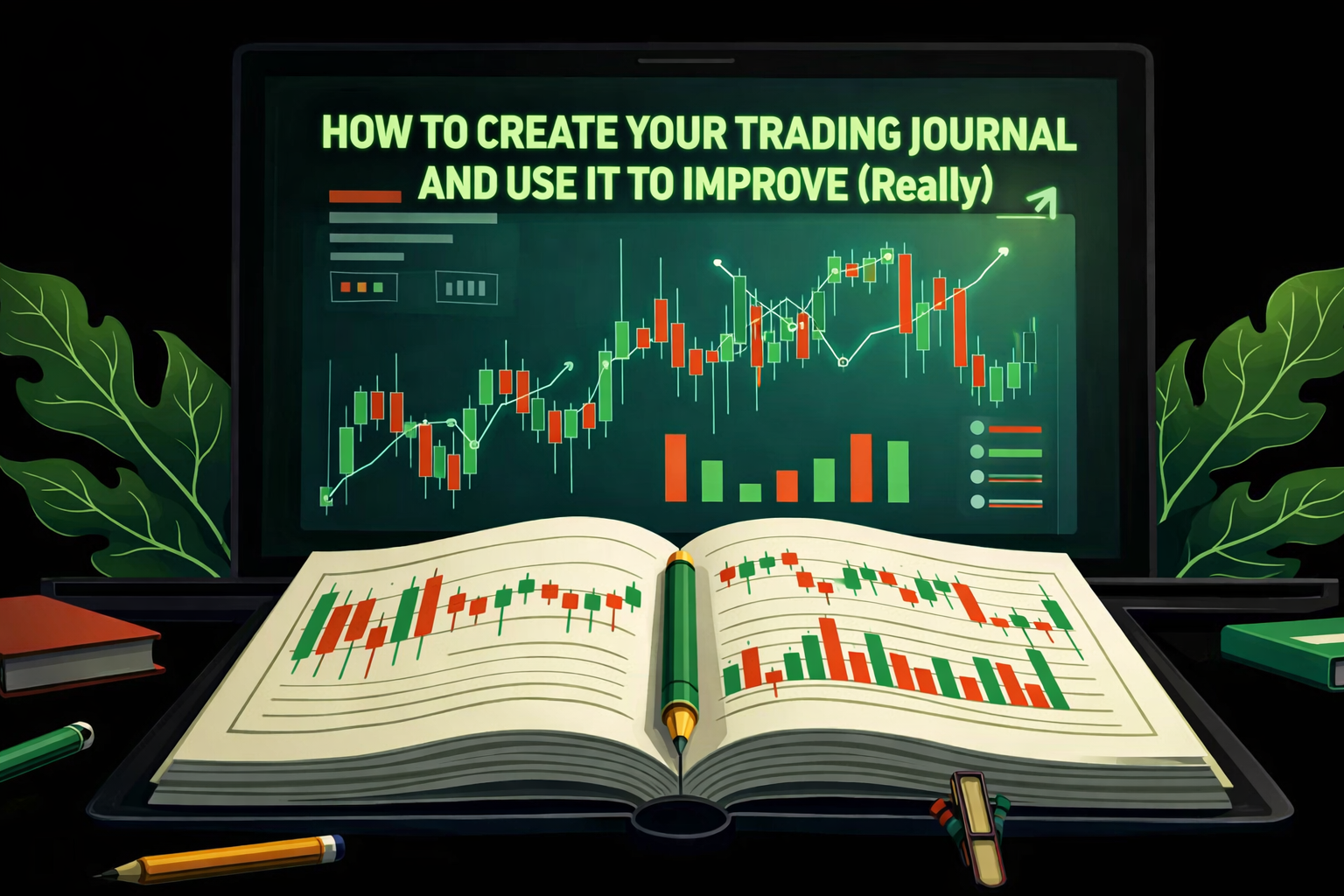
Every successful trader, from Wall Street legends to consistent retail professionals, has one thing in common: they meticulously track their performance. They don’t rely on memory, feelings, or luck. They rely on data. And the most powerful data-gathering tool at your disposal is a trading journal.
Many traders hear “trading journal” and either dismiss it as tedious homework or create one and abandon it after a week. They fail to see it for what it truly is: the ultimate performance-enhancement tool. It’s the mirror that shows you the unfiltered truth about your trading decisions, habits, and psychological flaws.
This guide is designed to be different. We’re not just going to tell you what to track; we’re going to show you how to use your journal to make tangible, lasting improvements. Forget theory. This is a practical, step-by-step framework you can apply today to transform your trading.
Why Your Trading Fails Without a Journal
Let’s be blunt: if you’re not keeping a detailed trading journal, you are not treating trading as a business. You’re gambling. A journal turns random actions into structured data, revealing patterns you would otherwise miss.
Without a journal, you are prone to:
- Repeating the Same Mistakes: You’ll make the same impulsive entries or exit trades too early, without ever identifying the root cause.
- Emotional Decision-Making: You’ll remember your big wins and forget the dozen small, undisciplined losses that wiped them out. A journal forces you to confront reality.
- Strategy Stagnation: You have no objective way to know if your strategy is actually working, what market conditions it thrives in, or what needs to be tweaked.
A journal is your personal trading coach, your psychologist, and your head of analytics, all rolled into one. It’s the foundation for building the daily habits that separate a mediocre trader from a consistent one.
Step 1: Building Your Trading Journal (The Right Way)
You can use a simple spreadsheet (like Google Sheets or Excel), a physical notebook, or specialized journaling software. The tool doesn’t matter as much as the data you collect. The key is to make it frictionless so you actually use it consistently.
Your journal should have two main components: the quantitative data (the numbers) and the qualitative data (the context and your mindset).
The Quantitative Data: What to Track for Every Trade
This is the objective “what, when, and how much” of your trading. Create columns for each of these data points:
- Date: The date of the trade.
- Asset: E.g., EUR/USD, NASDAQ, Gold.
- Setup/Strategy: The name of the specific strategy you used (e.g., “Break and Retest,” “Supply Zone Fade”). Be specific.
- Direction: Long or Short.
- Entry Price: The exact price at which you entered.
- Stop-Loss Price: Your initial stop-loss level.
- Take-Profit Price: Your initial profit target.
- Exit Price: The actual price at which you exited the trade.
- Position Size: The lot size or number of contracts.
- Risk/Reward Ratio (RRR): The potential reward of the trade divided by the potential risk.
- Profit/Loss (P/L): The final P/L in dollars and pips/points.
- Screenshot (Before): A screenshot of your chart before you enter, with your analysis and planned entry/exit levels marked.
- Screenshot (After): A screenshot of the chart after the trade is closed, showing how it played out.
This seems like a lot, but it’s the bare minimum for effective analysis. It provides an unshakeable record of your actions.
The Qualitative Data: Uncovering Your “Why”
This is where the real improvement happens. The numbers tell you what happened, but the qualitative section tells you why. Add these columns to your journal:
- Reason for Entry: In one or two sentences, why did you take this trade? What confluence of factors confirmed your setup?
- Reason for Exit: Why did you exit where you did? Was it your take-profit, your stop-loss, or did you manually close it? Be honest.
- Emotional State (Entry & Exit): How did you feel when you entered? Confident? Anxious? Impatient (FOMO)? How did you feel as you managed the trade and exited? Scared? Greedy?
- What Went Right?: What did you do well on this trade? Did you follow your plan perfectly? Did you manage risk correctly?
- What Went Wrong?: Where did you deviate from your plan? Did you enter too early? Widen your stop-loss? Exit out of fear?
- Lesson Learned: What is the single biggest takeaway from this trade that you can apply in the future?
This section is where you confront your trading psychology head-on. It’s not about judging yourself; it’s about observing your behavior so you can improve it. This is how you build the mindset that leads to real results, not just chase shortcuts.
Step 2: Using Your Journal to Actually Improve
A journal is useless if you don’t review it. This is the step most traders skip. Schedule a “Journal Review” session in your calendar for every weekend. During this session, you are not a trader; you are an analyst.
Your goal is to find patterns. Ask yourself these questions as you review the past week’s trades:
1. Which Strategy is Making (or Losing) the Most Money?
Filter your journal by “Setup/Strategy.” What is the total P/L for each strategy? You might discover that your “Break and Retest” strategy is consistently profitable, while your “Reversal” strategy is a consistent loser.
- Actionable Insight: Double down on what works and ruthlessly cut what doesn’t.
2. What Market Conditions Favor My Strategy?
Look at your winning trades. Were they mostly during the London session? On high-volatility days? When a certain indicator was overbought?
- Actionable Insight: You can refine your trading plan to only take trades during these optimal conditions, immediately increasing your win rate. A good starting point is our smart beginner’s guide to reading the markets.
3. What are My Most Common (and Costly) Mistakes?
Go to the “What Went Wrong?” column. Do you see a recurring theme?
- “I keep moving my stop-loss because I’m afraid of being wrong.”
- “I take profits too early on my winning trades.”
- “I force trades when I’m bored.”
- Actionable Insight: Identify your #1 recurring mistake. For the next week, make it your single mission to eliminate that one error. Focus on fixing one flaw at a time.
4. How is My Psychology Sabotaging Me?
Review your “Emotional State” column. Do your biggest losses happen when you feel “impatient” or “angry” (revenge trading)? Do you feel “fearful” and close good trades too soon?
- Actionable Insight: This uncovers the psychological triggers that lead to bad decisions. Once you are aware of them, you can create rules to counteract them (e.g., “If I lose two trades in a row, I will shut down my platform for an hour”). This is one of the surprising truths about Forex traders: the best ones are masters of their own psychology.
At OFP Funding, we believe that a trader’s success is built on discipline, data, and self-awareness—values that align perfectly with the importance of maintaining a trading journal. Our platform is designed to empower traders by providing instant funding, transparent rules, and a supportive community, so you can focus on refining your strategies and tracking your performance. With OFP, you gain access to the capital you need to trade professionally, without the distractions of challenges or hidden terms. Start your journey toward consistent profitability with the tools and support that make a difference. Learn more about how OFP is redefining the trading experience at OFP Funding.
OFP as Your Guide
Think of us at OFP Funding not just as a capital provider, but as a partner in your professional development. We provide the funding and the favorable trading conditions—instant access, no time limits—but your success hinges on your discipline and your commitment to improvement. A trading journal is your roadmap for that journey. We’ve explained prop firms and why they matter for traders who are serious about their craft; the journal is your primary tool.
The modern trader isn’t just a chart analyst; they are a data scientist of their own performance. For more on this, explore our insights on unveiling the modern Forex trader.
Conclusion: From Trader to Performance Analyst
Stop wishing for better results and start creating them. Your trading journal is the bridge between the trader you are today and the consistently profitable trader you want to become.
Your mission for this week is simple:
Build your journal using the template above.
Diligently record every single trade, including the qualitative data.
Schedule your first weekly review for this coming weekend.
It will feel like work at first, but within a month, you will have more clarity on your trading performance than you’ve had in your entire career. You will finally stop guessing and start knowing. That is the moment everything changes.
'%3e%3cellipse%20cx='694.451'%20cy='616.029'%20rx='390.451'%20ry='312.029'%20fill='var(--fill-0,%20%235473FF)'%20fill-opacity='0.49'/%3e%3c/g%3e%3cdefs%3e%3cfilter%20id='filter0_f_0_375'%20x='0'%20y='0'%20width='1388.9'%20height='1232.06'%20filterUnits='userSpaceOnUse'%20color-interpolation-filters='sRGB'%3e%3cfeFlood%20flood-opacity='0'%20result='BackgroundImageFix'/%3e%3cfeBlend%20mode='normal'%20in='SourceGraphic'%20in2='BackgroundImageFix'%20result='shape'/%3e%3cfeGaussianBlur%20stdDeviation='152'%20result='effect1_foregroundBlur_0_375'/%3e%3c/filter%3e%3c/defs%3e%3c/svg%3e)
'%3e%3cellipse%20cx='547.5'%20cy='498.5'%20rx='243.5'%20ry='194.5'%20fill='var(--fill-0,%20%235473FF)'%20fill-opacity='0.49'/%3e%3c/g%3e%3cdefs%3e%3cfilter%20id='filter0_f_0_102'%20x='0'%20y='0'%20width='1095'%20height='997'%20filterUnits='userSpaceOnUse'%20color-interpolation-filters='sRGB'%3e%3cfeFlood%20flood-opacity='0'%20result='BackgroundImageFix'/%3e%3cfeBlend%20mode='normal'%20in='SourceGraphic'%20in2='BackgroundImageFix'%20result='shape'/%3e%3cfeGaussianBlur%20stdDeviation='152'%20result='effect1_foregroundBlur_0_102'/%3e%3c/filter%3e%3c/defs%3e%3c/svg%3e)