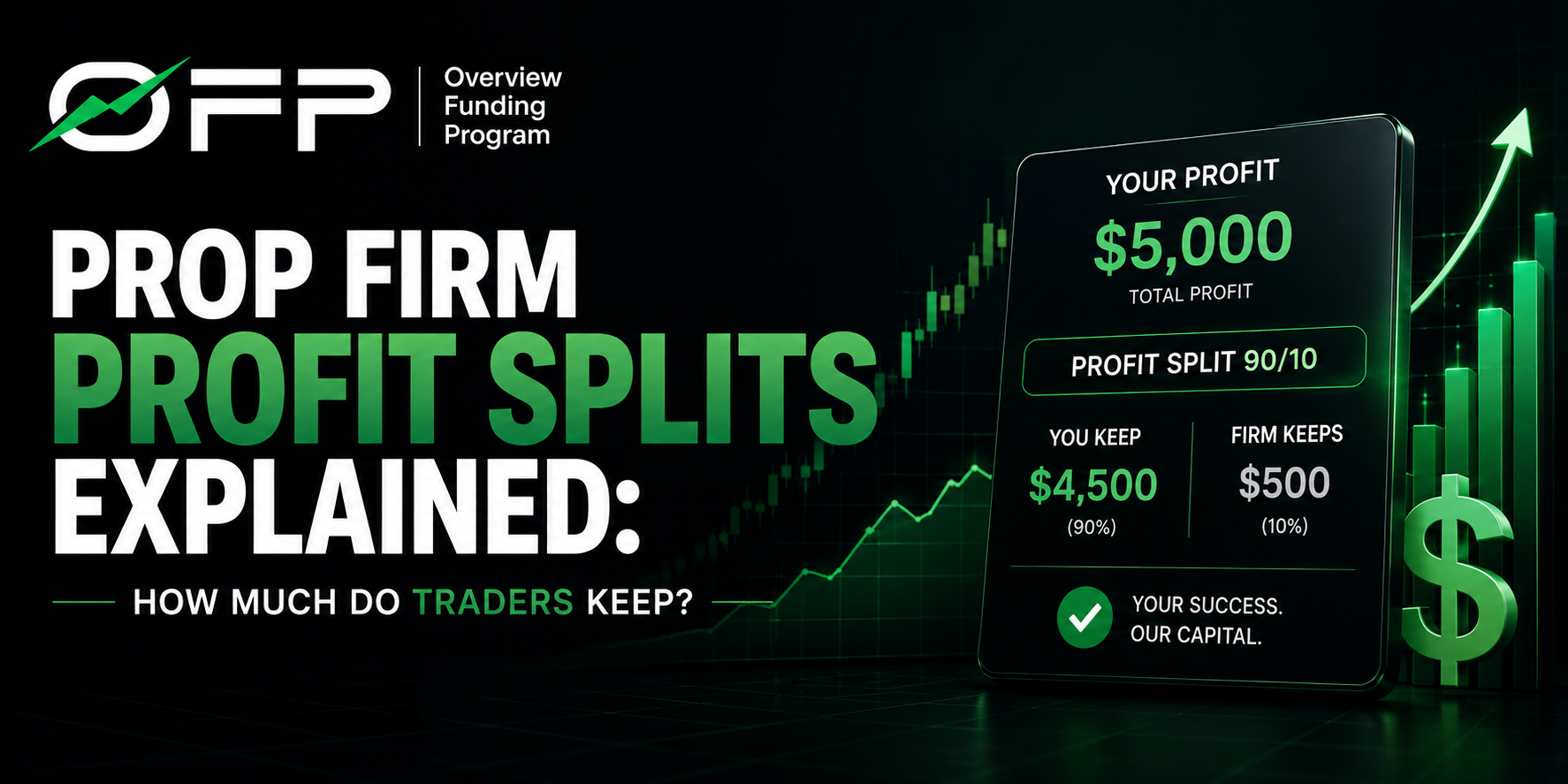
Prop Firm Profit Splits Explained: How Much Do Traders Keep?
One of the biggest attractions of proprietary trading is the ability to trade a significantly larger account without putting the same amount of personal capital at risk.
But once a trader starts generating profits, an important question comes up:
How much of those profits do you actually get to keep?
The answer comes down to one of the most important concepts in funded trading: the profit split.
A profit split determines how the profits generated by a trader are divided between the trader and the prop firm. At first glance, comparing profit splits seems simple: 80% is better than 70%, and 90% is better than 80%.
In reality, there is more to it.
The percentage is important, but so are payout conditions, account type, trading rules, minimum withdrawal requirements, consistency requirements, and how quickly you can access your profits.
In this article, we'll explain how profit split in prop trading works, how much traders can potentially keep, and what you should look at before choosing a funded trading account.
What Is a Profit Split in Prop Trading?
The term profit split in prop trading refers to the percentage of eligible trading profits that a trader receives from a proprietary trading firm.
For example, imagine a funded trader generates $10,000 in eligible profit and has a 90% profit split.
The calculation is straightforward:
- Trader's share: $9,000
- Firm's share: $1,000
- Total profit: $10,000
The trader doesn't need to provide $100,000 of personal capital to generate that $10,000 result. Instead, the trader operates within the firm's funded-account structure and follows its trading and risk rules.
This is one of the fundamental reasons funded trading has become attractive to experienced traders.
Why Does the Profit Split Matter?
The profit split directly affects your potential payout.
Consider two traders who each generate $10,000 in eligible profit.
The difference becomes even more significant as profits increase.
A trader generating $20,000 in eligible profit would receive $14,000 with a 70% split, but $18,000 with a 90% split.
That's a $4,000 difference from the same trading performance.
This is why profit split should be considered when comparing prop firms.
However, traders should avoid choosing a firm based exclusively on the highest advertised percentage.
A Higher Profit Split Isn't Always the Best Deal
A 95% profit split may look better than an 80% split, but that doesn't automatically mean the first account is better.
You should also examine:
- Account price
- Daily drawdown
- Maximum drawdown
- Maximum risk per trade
- Minimum withdrawal
- Payout frequency
- Consistency rules
- Minimum trading days
- News-trading restrictions
- Scaling conditions
- Platform and execution
- Whether the profit split changes over time
For example, an account offering 95% may have stricter conditions that make it harder to actually withdraw profits.
Meanwhile, an account offering 80% may provide more flexibility and allow a trader to withdraw more frequently.
The real question isn't simply "Who offers the highest profit split?"
It is:
"Which funding model allows me to keep the largest practical share of my profits while trading within rules that fit my strategy?"
How Do Prop Firm Profit Splits Work?
The process is generally straightforward.
1. Choose a Funded Account
The trader selects an account size and funding model.
Depending on the provider, this could be an instant-funded account or an evaluation/challenge account.
2. Trade According to the Rules
The trader generates profits while staying within the firm's risk parameters.
This is critical because profits generated while violating account rules may not qualify for a payout.
3. Meet the Payout Requirements
Before requesting a withdrawal, the trader may need to satisfy specific conditions.
These can include:
- Minimum trading days
- Minimum profit
- KYC verification
- Consistency requirements
- Compliance with risk rules
The exact requirements vary between firms.
4. Request the Payout
Once the requirements have been met, the trader submits a payout request.
5. Apply the Profit Split
The eligible profit is divided according to the account's applicable profit-sharing structure.
The trader receives their share, while the firm retains its portion.
What Does a 90/10 Profit Split Mean?
A 90/10 split means that the trader receives 90% of eligible profits and the firm receives 10%.
For example:
$1,000 profit → $900 to trader
$5,000 profit → $4,500 to trader
$10,000 profit → $9,000 to trader
$25,000 profit → $22,500 to trader
The mathematics are simple.
What matters more is whether the trader can consistently generate profits while remaining eligible for payouts.
That's why risk management and account rules remain just as important as the headline profit split.
What About a 100% Profit Split?
A 100% profit split means that the trader keeps the entire eligible profit under the applicable program terms.
OFP Funding currently advertises up to 100% profit split, and its current Instant Funding terms list 100% profit split for the Instant Lite, Instant Classic, Instant Pro and Instant Prime plans. (OFP Funding)
For example, with a 100% split:
$5,000 eligible profit → $5,000 to the trader
There is an obvious appeal here: if your trading performance generates $5,000 in eligible profit, the entire amount remains with you under the applicable payout terms.
But even with a 100% profit split, traders should still examine the complete account structure.
A high profit split doesn't remove drawdown limits, risk rules, trading restrictions or payout requirements.
In other words:
100% profit split does not mean 100% freedom.
The account rules still matter.
OFP Funding's Profit Split Structure
OFP Funding takes a flexible approach to funded trading, with different account models designed around different trading preferences.
Its current offering highlights up to 100% profit split, while the specific conditions vary according to the selected program. (OFP Funding)
This is important because traders don't all need the same account.
Someone looking for a straightforward instant-funded model may have different priorities from a trader who prefers an evaluation process.
OFP's current Instant Funding plans include different account sizes and risk structures, while the terms specify the applicable profit split and other conditions for each plan.
For traders who already have a tested strategy and want to avoid spending weeks going through an evaluation, instant funding can be particularly attractive.
That's also why understanding the broader concept of instant funding is important before comparing individual profit splits.
Profit Split vs. Payout Frequency
This is an area that traders sometimes overlook.
Imagine two firms:
Firm A
- 90% profit split
- Payout once per month
Firm B
- 80% profit split
- More frequent payout opportunities
Which one is better?
There isn't necessarily one correct answer.
If a trader generates $5,000 in eligible profit, the 90% split gives them $4,500, while the 80% split gives them $4,000.
But if the second firm's payout structure better matches the trader's cash-flow needs, the difference in percentage may not be the only consideration.
This is why profit split and payout frequency should always be evaluated together.
OFP Funding vs. FTMO vs. FundedNext
When comparing major prop firms, profit split is one of the easiest features to compare—but the structures aren't always directly equivalent.
FTMO currently advertises up to 90% of simulated profits, with its 1-Step and 2-Step models having different structures and objectives. (FTMO.com)
FundedNext uses different reward-share structures depending on the account model. For example, its Stellar 2-Step account currently provides an 80% reward share in the FundedNext Account, with the possibility of increasing to 90% through progression. Other FundedNext models have different structures. (FundedNext)
OFP Funding, meanwhile, currently advertises up to 100% profit split, with its current Instant Funding terms listing 100% for the specified Instant Funding plans. (OFP Funding)
This makes the comparison more interesting than simply looking at one percentage.
When evaluating OFP Funding vs FTMO vs FundedNext, traders should compare the entire structure:
- Profit split
- Account cost
- Drawdown
- Payout requirements
- Payout frequency
- Consistency rules
- Scaling
- Trading restrictions
- Account type
- Maximum account size
This is where a seemingly small difference in profit split can become much more or less valuable depending on the rest of the account conditions.
How to Maximize Your Take-Home Profit
Getting a high profit split is only one part of maximizing your payout.
Trade Consistently
Consistent performance is more valuable than trying to generate one enormous winning day.
Control Risk
A large profit split means little if the account is lost because of excessive risk.
Understand Payout Conditions
Know exactly when you can request a payout and what conditions must be satisfied.
Choose the Right Account
Don't automatically select the largest account.
Choose an account whose drawdown and risk parameters match your strategy.
Look Beyond the Headline Percentage
A 100% profit split can be attractive, but you should still evaluate the complete ruleset.
The best account is one where you can trade comfortably, remain compliant and consistently withdraw profits.
Why Profit Split Should Be Part of Your Prop Firm Research
Profit split is one of the clearest ways to understand the economics of a funded trading account.
But it shouldn't be viewed in isolation.
A trader should ask:
How much do I keep?
Then immediately ask:
How difficult is it to generate and withdraw that profit?
That second question is where the real comparison begins.
A prop firm can advertise an impressive percentage, but traders need to understand the rules surrounding that percentage before deciding whether an account is appropriate.
For traders looking for an instant-funded solution, OFP's current offering combines immediate access with profit-sharing structures designed to let traders retain a substantial portion of eligible profits. The current offering advertises up to 100% profit split, alongside different account models and risk parameters.
Key Takeaways
- A profit split determines how eligible trading profits are divided between the trader and the prop firm.
- A 90% split means the trader keeps $900 from every $1,000 of eligible profit.
- A higher percentage isn't automatically better; payout conditions and trading rules matter.
- Payout frequency can be just as important as the advertised profit split.
- OFP Funding currently offers account models with up to 100% profit split.
- Traders should compare the complete account structure rather than choosing a firm based on one number.
- Strong risk management remains essential regardless of the profit split.
Frequently Asked Questions
What is a profit split in prop trading?
A profit split is the percentage of eligible trading profits that a funded trader receives from a proprietary trading firm.
What is a 90% profit split?
A 90% profit split means the trader receives 90% of eligible profits and the firm retains the remaining 10%.
Is a 100% profit split possible?
Yes. Some prop firms offer 100% profit-sharing structures on certain programs. OFP Funding currently lists 100% profit split for its current Instant Funding plans.
Does a higher profit split mean a better prop firm?
Not necessarily. Traders should also compare drawdown, payout rules, account fees, consistency requirements, trading restrictions and scaling conditions.
How much would I receive from a $10,000 profit with a 90% split?
You would receive $9,000, assuming the entire $10,000 is eligible for payout and all applicable requirements have been met.
What should I look for besides the profit split?
Look at the complete account structure, including drawdown, risk limits, payout frequency, minimum withdrawal, trading restrictions and scaling opportunities.
Recommended internal links for this article
I would add these as we build the cluster:
- Instant Funded Trading: The Complete Guide to Funded Trading Accounts → pillar article
- FTMO → your dedicated FTMO article
- FundedNext → your dedicated FundedNext article
- How Do Prop Firm Payouts Work? → next supporting article
- What Is Daily Drawdown in Prop Trading? → previous article
For the pillar link, the first occurrence of the main keyword should point to the pillar, while later mentions can remain unlinked. This keeps the internal-linking structure natural rather than over-optimized.
'%3e%3cellipse%20cx='694.451'%20cy='616.029'%20rx='390.451'%20ry='312.029'%20fill='var(--fill-0,%20%235473FF)'%20fill-opacity='0.49'/%3e%3c/g%3e%3cdefs%3e%3cfilter%20id='filter0_f_0_375'%20x='0'%20y='0'%20width='1388.9'%20height='1232.06'%20filterUnits='userSpaceOnUse'%20color-interpolation-filters='sRGB'%3e%3cfeFlood%20flood-opacity='0'%20result='BackgroundImageFix'/%3e%3cfeBlend%20mode='normal'%20in='SourceGraphic'%20in2='BackgroundImageFix'%20result='shape'/%3e%3cfeGaussianBlur%20stdDeviation='152'%20result='effect1_foregroundBlur_0_375'/%3e%3c/filter%3e%3c/defs%3e%3c/svg%3e)
'%3e%3cellipse%20cx='547.5'%20cy='498.5'%20rx='243.5'%20ry='194.5'%20fill='var(--fill-0,%20%235473FF)'%20fill-opacity='0.49'/%3e%3c/g%3e%3cdefs%3e%3cfilter%20id='filter0_f_0_102'%20x='0'%20y='0'%20width='1095'%20height='997'%20filterUnits='userSpaceOnUse'%20color-interpolation-filters='sRGB'%3e%3cfeFlood%20flood-opacity='0'%20result='BackgroundImageFix'/%3e%3cfeBlend%20mode='normal'%20in='SourceGraphic'%20in2='BackgroundImageFix'%20result='shape'/%3e%3cfeGaussianBlur%20stdDeviation='152'%20result='effect1_foregroundBlur_0_102'/%3e%3c/filter%3e%3c/defs%3e%3c/svg%3e)