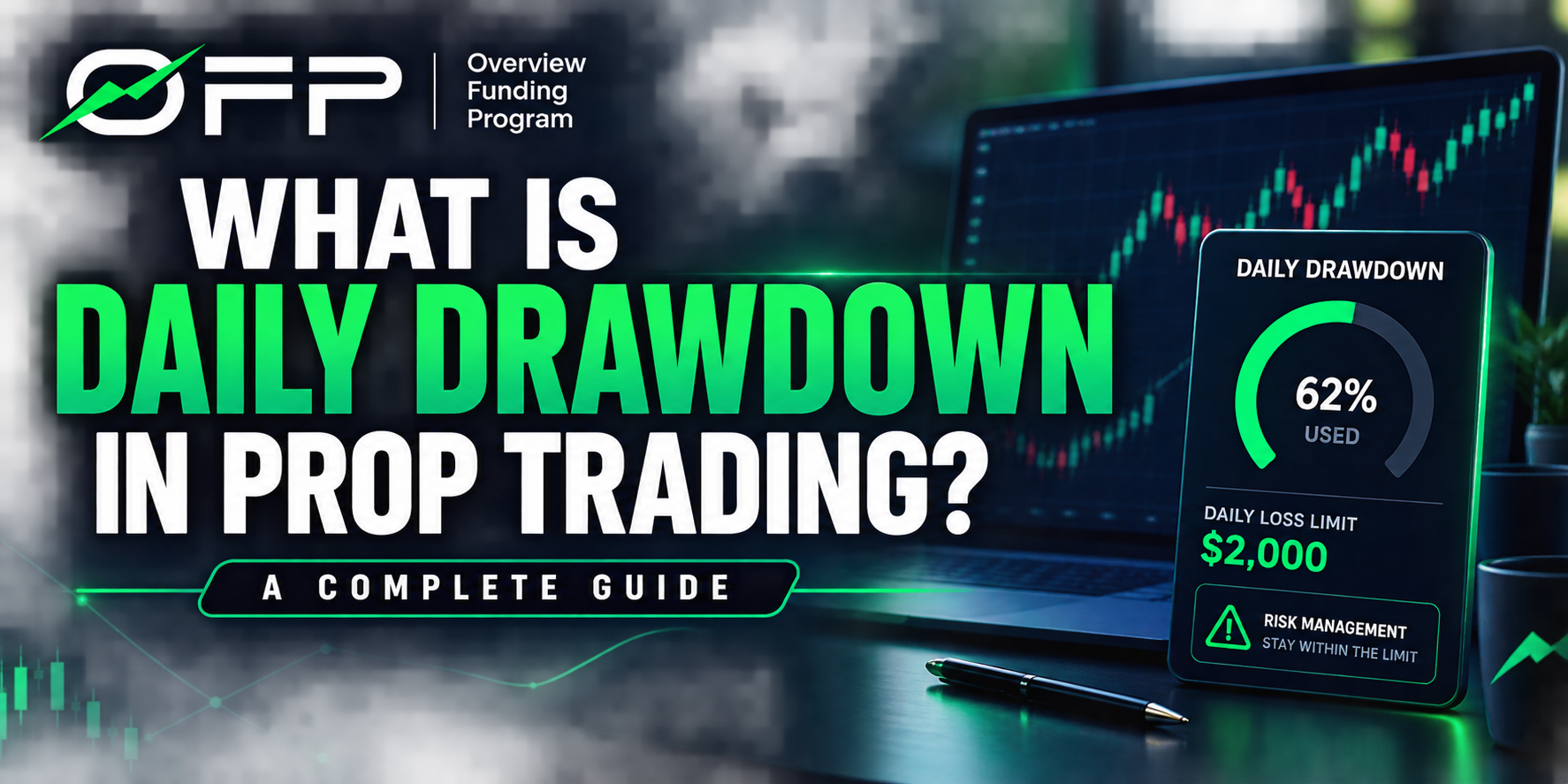
What Is Daily Drawdown in Prop Trading? A Complete Guide
When you trade with a proprietary trading firm, understanding the rules of your account is just as important as understanding the markets.
One of the most important rules to understand is daily drawdown.
Daily drawdown defines how much an account can lose within a single trading day. It is designed to prevent excessive risk and large losses in a short period of time. For funded traders, misunderstanding this rule can result in an account violation even when the trader is profitable overall.
In this guide, we'll explain what daily drawdown means, how it is calculated, how it differs from maximum overall drawdown, and how traders can manage their risk to stay within the limit.
What Is Daily Drawdown in Prop Trading?
Daily drawdown is the maximum amount an account can lose during a specific trading day before the account violates its risk limit.
The important point is that daily drawdown is measured separately from your overall account performance.
For example, imagine a trader has a $100,000 account with a 5% daily drawdown limit.
A 5% daily drawdown means the trader has a maximum daily loss threshold of $5,000.
If the applicable starting equity for the day is $100,000, the account must not fall below $95,000 during that trading day.
If the account reaches the daily loss threshold, the account may be considered to have violated the trading rules.
The exact calculation and consequences depend on the prop firm's specific rules, so traders should always check the conditions attached to their particular account.
Why Do Prop Firms Use Daily Drawdown?
Daily drawdown is primarily a risk-management mechanism.
Without a daily loss limit, a trader could potentially lose a substantial portion of an account in just a few trades or during one volatile market session.
A daily drawdown rule encourages traders to:
- Control position sizes
- Limit the amount they risk per trade
- Avoid revenge trading
- Stop trading after a difficult session
- Avoid excessive leverage
- Follow a consistent trading plan
- Protect their account during volatile market conditions
The goal isn't necessarily to prevent traders from taking trades. Instead, it creates a framework in which losses remain controlled.
For a funded trader, this distinction is important. Successful trading isn't only about making profitable trades. It is also about protecting capital when the market moves against you.
How Is Daily Drawdown Calculated?
There is no universal calculation used by every prop firm.
Different firms can use different methodologies, including:
- Starting balance
- Starting equity
- Previous day's closing equity
- Highest balance during the day
- Highest equity during the day
- Static or trailing thresholds
This is why traders should never assume that a 5% daily drawdown means exactly the same thing across every funded account.
OFP Funding's Daily Drawdown Calculation
According to OFP Funding's current Help Center, the daily drawdown calculation is based on the equity recorded at the end of the previous trading day.
The formula is:
Maximum Daily Loss = Previous Day's Closing Equity × Maximum Daily Loss Percentage
For example, suppose an account finishes Monday with equity of $105,000 and has a 5% maximum daily loss.
The calculation would be:
$105,000 × 5% = $5,250
The daily threshold for Tuesday would therefore be:
$105,000 − $5,250 = $99,750
The trader must keep the account's equity above the applicable threshold during that trading day.
OFP states that equity is recorded at the end of each trading day at midnight GMT+2, with daylight-saving adjustments, and that the daily calculation resets each day based on the new closing equity.
Because account rules can change and different OFP plans can have different parameters, traders should always verify the rules associated with the specific account they purchase.
Daily Drawdown vs. Maximum Overall Drawdown
Daily drawdown and maximum overall drawdown are related, but they are not the same thing.
Daily Drawdown
Daily drawdown limits how much you can lose during a particular trading day.
Think of it as a daily safety barrier.
Maximum Overall Drawdown
Maximum overall drawdown limits how far the account can decline over the applicable trading period.
Think of it as the account's larger risk boundary.
A trader can therefore remain above the overall drawdown limit while still violating the daily drawdown rule.
For example:
Imagine a $100,000 account with:
- 5% daily drawdown
- 10% maximum overall drawdown
The trader could potentially have plenty of room under the overall drawdown limit while still violating the account by losing 5% in one day.
This is why funded traders need to monitor both limits simultaneously.
Does Daily Drawdown Include Open Trades?
This is one of the most important questions for funded traders.
The answer depends on the firm's specific rules and whether the calculation is based on balance, equity, or another measurement.
Equity includes unrealized profit and loss from open positions, while balance generally reflects closed trades.
This distinction can become extremely important.
Imagine a trader has several open positions that are currently losing money. The account balance might still look acceptable because the trades have not been closed, but the account's equity could already be approaching the daily loss threshold.
For this reason, traders should understand exactly what their prop firm monitors before opening positions.
OFP's current documentation specifically describes its daily drawdown calculation in terms of account equity at the relevant daily reference point.
When Does Daily Drawdown Reset?
Daily drawdown normally resets according to the prop firm's defined trading-day schedule.
For OFP Funding, the Help Center states that the daily calculation resets at midnight GMT+2 with daylight-saving adjustments, using the newly recorded end-of-day equity.
This creates an important distinction:
A new trading day does not necessarily mean your account returns to its original starting balance.
Instead, the new daily limit can be calculated using the applicable previous-day closing equity.
This is why traders should know the exact reset time for their account and avoid assuming that the daily limit is always calculated from the original account size.
What Happens If You Hit the Daily Drawdown?
The consequences depend on the rules of the specific prop firm and account.
For OFP Funding, its current Help Center states that if equity drops below the applicable daily limit, the challenge fails immediately and the account can be closed.
This means that traders should not treat the daily drawdown as a target.
For example, if your daily limit is $5,000, that does not mean you should routinely risk $5,000.
The limit is a maximum boundary, not a recommended trading risk.
A much more sensible approach is to create your own internal risk limit below the firm's maximum.
How to Avoid Hitting Daily Drawdown
The best way to avoid a daily drawdown violation is to manage risk before entering a trade.
1. Set a Personal Daily Loss Limit
Don't wait until you reach the firm's maximum.
If your prop firm allows a 5% daily drawdown, you might establish a personal stop-trading threshold considerably lower than that.
This gives you a buffer for unexpected market movements.
2. Control Risk Per Trade
Risking a large percentage of the account on a single position can make the daily limit surprisingly easy to hit.
A consistent position-sizing strategy can help prevent one losing trade from damaging the entire trading session.
3. Avoid Revenge Trading
One losing trade can quickly become several losing trades when emotions take control.
A trader who tries to immediately recover a loss may increase position sizes or abandon their strategy.
That behavior is particularly dangerous when a daily drawdown limit exists.
4. Monitor Equity, Not Just Balance
If your account rules use equity, watching only the balance isn't enough.
Open positions can affect equity before they are closed.
Make sure you understand which measurement the prop firm uses.
5. Be Careful During Volatile Markets
Major economic announcements can produce rapid price movements and wider spreads.
Even a strategy that normally operates well can behave differently during extreme volatility.
Always understand the firm's news-trading rules before trading major releases.
6. Stop Trading When Your Plan Says to Stop
One of the most effective risk-management techniques is also one of the simplest:
Know when to stop.
If you have reached your personal daily loss limit, there is usually little benefit in forcing additional trades simply because you want to finish the day in profit.
A Simple Daily Drawdown Example
Consider a hypothetical $50,000 funded account with a 5% daily drawdown.
The maximum daily loss would be:
$50,000 × 5% = $2,500
If the applicable daily reference equity is $50,000, the account should not fall below:
$50,000 − $2,500 = $47,500
Suppose the trader loses:
- Trade 1: −$500
- Trade 2: −$400
- Trade 3: −$600
Total loss:
−$1,500
The trader still has $1,000 of theoretical room before reaching the $2,500 daily limit.
However, that doesn't necessarily mean another $1,000 of risk is sensible.
A disciplined trader might decide that a $1,500 loss is already enough for the day and stop trading.
That difference—between the firm's maximum allowed loss and the trader's own risk limit—is fundamental to good risk management.
Daily Drawdown Is a Risk Rule, Not a Trading Strategy
It is easy to think about drawdown purely as a restriction.
A better way to view it is as a framework for disciplined trading.
If you know that your account has a defined daily loss limit, you can build your trading strategy around it.
For example, you can establish:
- Maximum risk per trade
- Maximum number of trades per session
- Maximum daily loss
- Maximum number of consecutive losses
- Minimum risk-to-reward ratio
- Conditions that require you to stop trading
This turns the prop firm's rules into part of your trading plan.
What Should Traders Look for When Comparing Prop Firms?
Daily drawdown should be one of the first things traders compare when evaluating a funded trading account.
Don't look only at the percentage.
Also ask:
What is the drawdown calculated from?
Is it based on balance or equity?
Is the limit static or trailing?
When does the trading day reset?
Does the limit change after profitable days?
What happens if the threshold is reached?
Are there separate maximum-risk rules?
Are there other restrictions that interact with drawdown?
A seemingly attractive account can have a very different risk profile depending on how these rules are structured.
OFP Funding currently provides dedicated documentation explaining daily drawdown, maximum drawdown, risk limits and other trading rules, which traders should review before trading an account.
Daily Drawdown: OFP Funding vs FTMO vs FundedNext
Daily drawdown rules can vary considerably between prop firms, so traders should look beyond the percentage alone and understand how each company calculates its limit.
OFP Funding uses the equity recorded at the end of the previous trading day as the reference point, with the applicable daily drawdown percentage depending on the selected plan.
Current OFP models offer daily drawdown levels of 3% or 5%, with the limit recalculated each day based on the previous day's closing equity.
FTMO also recalculates its Maximum Daily Loss each day, but its current structure varies by account: the 1-Step model uses a 3% maximum daily loss, while the 2-Step model uses 5%.
FTMO calculates the limit from the account balance at the daily reset and applies it to equity, including open-position P/L, commissions and swaps.
FundedNext offers different daily-loss structures depending on the model. For example, its Stellar 2-Step model uses 5%, Stellar 1-Step uses 3%, and Stellar Lite uses 4%, while its Stellar Instant model currently has no daily loss limit and instead uses a trailing maximum loss limit. This means that the "best" daily drawdown structure ultimately depends on the trader's strategy, risk tolerance and preferred funding model.
Frequently Asked Questions
What is daily drawdown in prop trading?
Daily drawdown is the maximum loss an account can sustain during a defined trading day before the trader violates the firm's risk rules.
Is daily drawdown the same as maximum drawdown?
No. Daily drawdown applies to a specific trading day, while maximum overall drawdown defines the larger loss boundary for the account.
Is a 5% daily drawdown good?
A higher daily drawdown provides more room for losses, but that doesn't necessarily make an account better. Traders should evaluate the complete risk structure, including overall drawdown, leverage, risk limits and other rules.
Does daily drawdown reset every day?
Usually, but the exact reset time and calculation method depend on the prop firm. OFP Funding currently states that its daily calculation resets at midnight GMT+2 with daylight-saving adjustments.
Can I lose my funded account because of daily drawdown?
Yes. Violating the applicable daily drawdown limit can result in account closure or failure, depending on the account's rules.
How can I avoid daily drawdown violations?
Use controlled position sizes, define your own daily loss limit, monitor equity, avoid revenge trading and understand exactly how your prop firm's drawdown calculation works.
Final Thoughts
Understanding daily drawdown is essential for anyone considering a funded trading account.
The most important lesson is simple: don't treat the firm's maximum loss limit as your personal trading budget.
A professional approach is to create your own risk-management rules well inside the firm's limits. This gives you room to handle losing trades without immediately approaching an account violation.
Before trading any funded account, make sure you understand the daily drawdown calculation, reset time, overall drawdown, maximum-risk rules and any additional trading restrictions.
When you understand these rules before placing your first trade, drawdown becomes much less of a surprise—and much more of a risk-management tool.
'%3e%3cellipse%20cx='694.451'%20cy='616.029'%20rx='390.451'%20ry='312.029'%20fill='var(--fill-0,%20%235473FF)'%20fill-opacity='0.49'/%3e%3c/g%3e%3cdefs%3e%3cfilter%20id='filter0_f_0_375'%20x='0'%20y='0'%20width='1388.9'%20height='1232.06'%20filterUnits='userSpaceOnUse'%20color-interpolation-filters='sRGB'%3e%3cfeFlood%20flood-opacity='0'%20result='BackgroundImageFix'/%3e%3cfeBlend%20mode='normal'%20in='SourceGraphic'%20in2='BackgroundImageFix'%20result='shape'/%3e%3cfeGaussianBlur%20stdDeviation='152'%20result='effect1_foregroundBlur_0_375'/%3e%3c/filter%3e%3c/defs%3e%3c/svg%3e)
'%3e%3cellipse%20cx='547.5'%20cy='498.5'%20rx='243.5'%20ry='194.5'%20fill='var(--fill-0,%20%235473FF)'%20fill-opacity='0.49'/%3e%3c/g%3e%3cdefs%3e%3cfilter%20id='filter0_f_0_102'%20x='0'%20y='0'%20width='1095'%20height='997'%20filterUnits='userSpaceOnUse'%20color-interpolation-filters='sRGB'%3e%3cfeFlood%20flood-opacity='0'%20result='BackgroundImageFix'/%3e%3cfeBlend%20mode='normal'%20in='SourceGraphic'%20in2='BackgroundImageFix'%20result='shape'/%3e%3cfeGaussianBlur%20stdDeviation='152'%20result='effect1_foregroundBlur_0_102'/%3e%3c/filter%3e%3c/defs%3e%3c/svg%3e)